Last Supper Rugs and the Story Behind the Iconic Image
The Last Supper is one of the most recognized scenes in Christian art—a moment of profound emotion, symbolic meaning, and spiritual significance. While most people know this composition through Western paintings, especially Leonardo da Vinci’s version, it also appears in a surprising and beautiful medium: handmade Persian pictorial rugs. Among these, Last Supper Rugs woven in Tabriz stand out for their meticulous workmanship, cultural richness, and respectful reinterpretation of a sacred narrative.
This blog explores the meaning of the Last Supper, the story behind Leonardo’s painting, and why Persian weavers chose to bring this celebrated scene into their own artistic tradition.
The Last Supper — A Moment That Shaped Christian Art
The Last Supper represents Christ’s final meal with His twelve apostles before His crucifixion. According to the Gospels, this is the moment when Jesus reveals that one of His closest followers will betray Him. The room erupts in shock, disbelief, and emotional turmoil—an intensity that artists across centuries have tried to capture.
This event also introduces the foundational Christian ritual of Communion. Because of its spiritual weight, the Last Supper became a central theme in religious art, symbolizing sacrifice, loyalty, betrayal, forgiveness, and divine purpose. It is a scene layered with emotional depth, each apostle embodying a different response—fear, confusion, devotion, or anxiety.
Leonardo da Vinci’s Last Supper and Its Enduring Influence
Leonardo da Vinci painted The Last Supper between 1495 and 1498 on the wall of Santa Maria delle Grazie in Milan. Rather than using traditional fresco techniques, Leonardo experimented with oil and tempera on dry plaster, seeking a softness and realism unattainable in traditional fresco. While the technique caused the artwork to deteriorate over the centuries, it also allowed Leonardo to achieve the expressive detail that makes the piece so unforgettable.
Three aspects define Leonardo’s masterpiece:
1. Emotional Expression
Leonardo was fascinated by human psychology. Each apostle reacts differently—some rise abruptly, others lean forward, and some gesture in disbelief. This vivid emotional realism was revolutionary for its time.
2. Divine Calm at the Center
Christ is positioned at the exact center of the composition. While chaos unfolds around Him, His posture remains composed and grounded, symbolizing spiritual clarity within human turmoil.
3. Dramatic Perspective
Leonardo used masterful perspective to draw the viewer’s gaze directly toward Christ. The architectural lines, ceiling beams, and windows all guide the eye toward Him as the focal point.
This combination of emotional storytelling and technical innovation made The Last Supper one of the most studied artworks in history. Its influence even reached the world of Persian weaving.
Last Supper Rugs — The Scene Reimagined in Persian Weaving
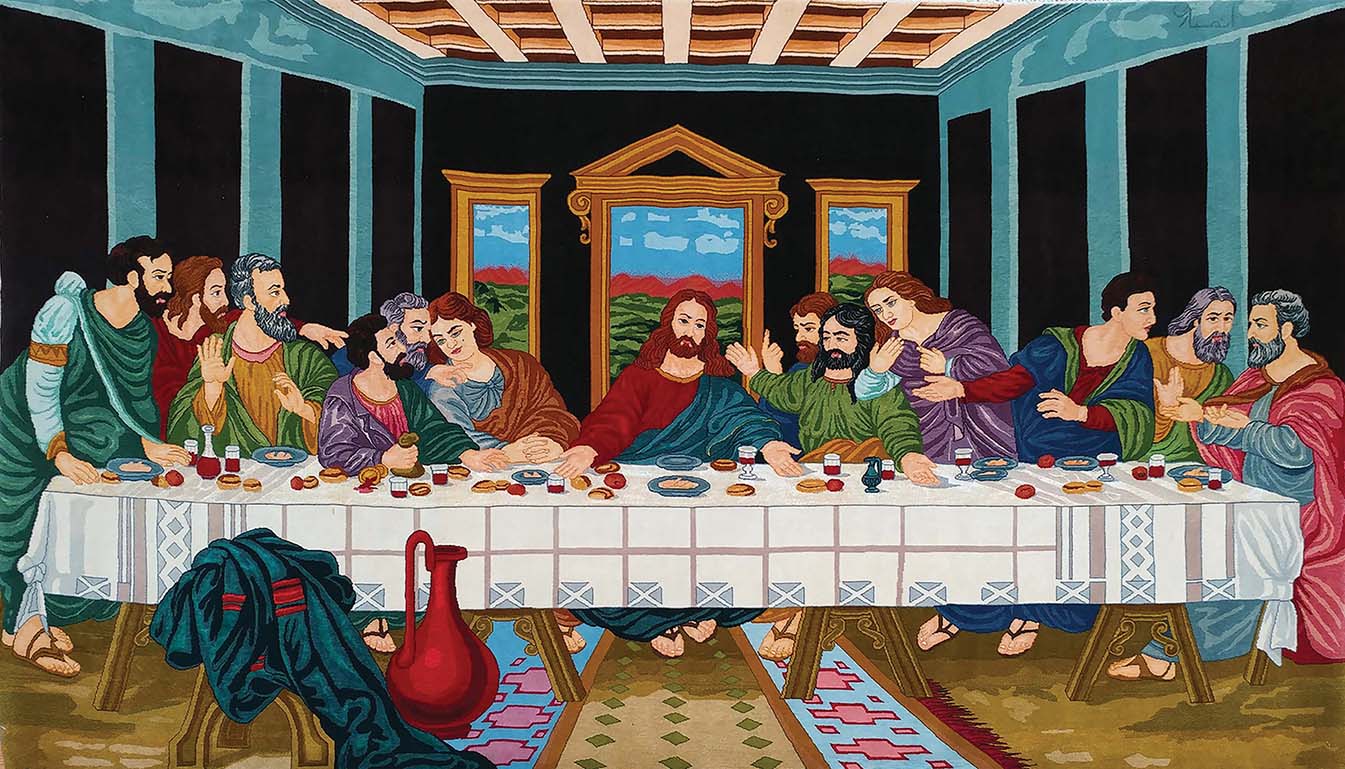
Persian weavers, particularly in Tabriz, have long woven pictorial rugs that depict historical scenes, legends, royal portraits, and religious subjects. Among these, Last Supper Rugs hold a special place. They do not aim to replicate Leonardo’s mural exactly—instead, they reinterpret it through the Persian artistic lens.
Key characteristics include:
-
Rich Persian color palettes such as emerald, deep red, turquoise, black, and white
-
Fine wool and silk detailing that create depth, texture, and clarity
-
Persianized drapery and garment styling blending Eastern and Western aesthetics
-
Pictorial borders or architectural framing reflecting classical Tabriz design
-
Meticulous knotting typical of Tabriz craftsmanship, ensuring clarity of faces and gestures
A Last Supper Rug is not simply a textile. It is a cultural bridge—an artistic handshake between Renaissance Italy and Persian weaving tradition.
Tabriz — A City Known for Artistic Precision
Tabriz, one of the oldest carpet-weaving centers in Iran, is celebrated for its expertise in pictorial and narrative rugs. Its artisans work with exceptional attention to detail, often using wool on a silk foundation or combining wool and silk for elegant contrasts.
Tabriz weavers approach complex scenes like the Last Supper with:
-
disciplined drawing
-
mastery of proportion
-
strong color theory
-
deep respect for artistic subjects
This makes the city the perfect place for weaving a scene as intricate as Leonardo’s composition.
Cultural Dialogue Woven in Wool and Silk
The existence of Last Supper Rugs shows how art travels beyond borders. Throughout history, Iran maintained cultural exchanges with Armenians, Assyrians, and Europeans through trade routes, diplomacy, and religious communities. Artistic ideas flowed freely between East and West, and images such as the Last Supper naturally found new expressions in Persian workshops.
A Persian Last Supper Rug embodies:
-
Christian narrative
-
Persian craftsmanship
-
Renaissance composition
-
Middle Eastern textile heritage
It is a work that honors faith, storytelling, and cross-cultural respect.
Conclusion — A Timeless Story Preserved Through Persian Craft
Whether displayed in a home, gallery, church, or private collection, a Last Supper Rug is more than a decorative piece. It is an artistic dialogue between worlds—Leonardo’s vision expressed through Persian hands. These rugs celebrate shared human themes of devotion, sacrifice, and community, captured in a medium that has carried stories for centuries.